
Why Your Resume Gets Rejected in Just 6 Seconds
Discover why recruiters reject resumes within seconds and learn powerful resume tips to improve ATS ranking, job application success, and interview chances in 2026.

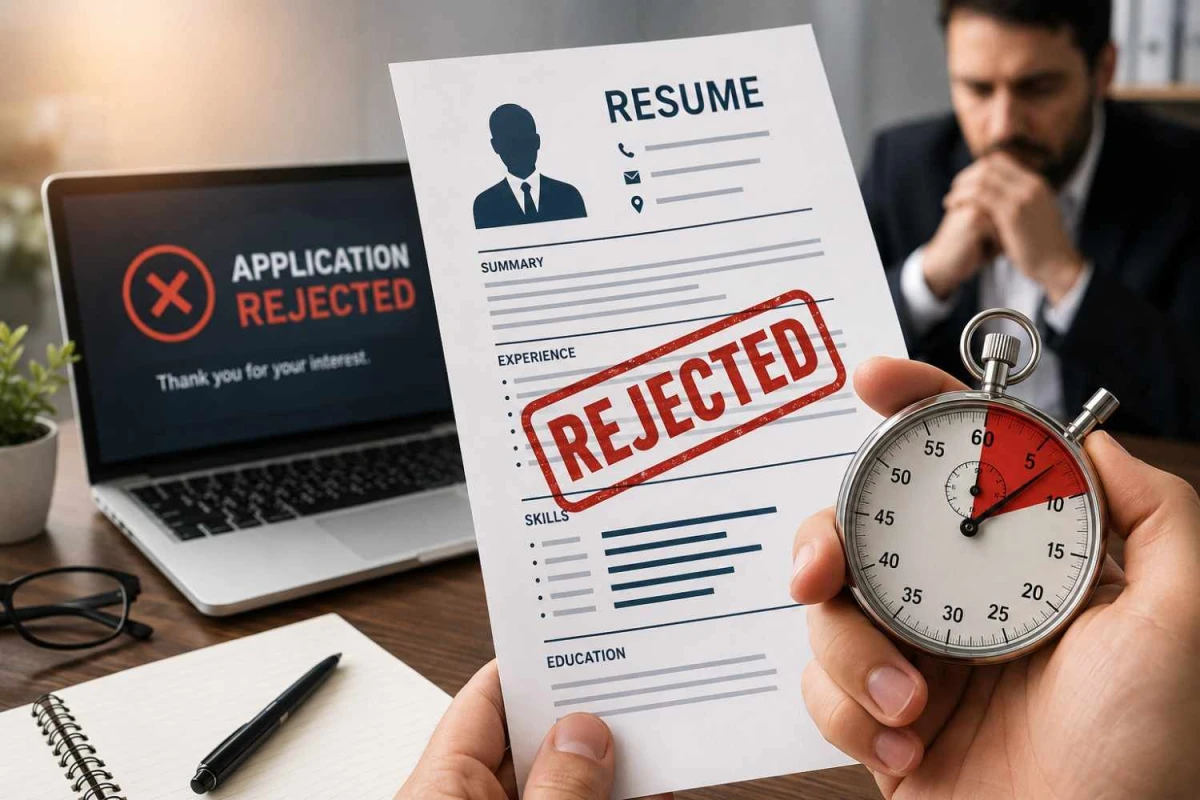
Why Your Resume Gets Rejected in Just 6 Seconds
You spend hours creating your resume.
You update skills, add experience, adjust formatting, and apply to dozens of jobs with hope.
But then nothing happens.
No interview calls.
No recruiter response.
No updates.
The reality is harsh: most resumes are rejected within just a few seconds.
In today’s competitive hiring market, recruiters receive hundreds of applications for a single role. They simply do not have enough time to read every resume in detail. Instead, they quickly scan resumes to decide whether a candidate matches the role or not.
If your resume fails to create a strong first impression immediately, it gets skipped.
And in many cases, the rejection happens before a human even reads it.
The Truth About the 6-Second Resume Scan
Studies and recruiter behavior show that hiring managers usually spend only a few seconds scanning a resume initially.
During this short scan, recruiters mainly check:
- Job title relevance
- Skills matching the role
- Work experience
- Career growth
- Achievements
- Resume structure
- ATS-friendly keywords
If these things are difficult to find or poorly presented, your application quickly moves to the rejection pile.
This does not always mean you are unqualified.
Sometimes the problem is simply how your resume communicates your value.
Why Most Resumes Get Rejected
1. Your Resume Looks Difficult to Read
First impressions matter.
A resume filled with large paragraphs, multiple colors, fancy graphics, or inconsistent formatting becomes hard to scan quickly.
Recruiters prefer resumes that are:
- Clean
- Professional
- Well-structured
- Easy to navigate
If important information is hidden inside cluttered design, recruiters may lose interest instantly.
Simple resumes often perform better than overly designed ones.
2. You’re Using the Same Resume for Every Job
One of the biggest mistakes candidates make is sending the same generic resume everywhere.
Modern companies use ATS (Applicant Tracking Systems) to filter applications automatically. These systems scan resumes for keywords related to the job description.
For example:
- A marketing role may require SEO, Meta Ads, Google Analytics
- A developer role may require Laravel, React, AWS, APIs
- An HR role may require recruitment, onboarding, payroll
If your resume lacks the right keywords, ATS software may reject it before a recruiter even sees it.
Customizing your resume for each role dramatically improves your chances.
How ATS Systems Reject Resumes
Many candidates still do not understand how ATS works.
ATS software is designed to save recruiters time by filtering applications automatically. It checks:
- Keywords
- Skills
- Experience relevance
- Resume formatting
- Job titles
If your resume does not align with the job description, the system may rank your application lower.
That’s why keyword optimization is now essential in job searching.
A strong resume is not just written for humans anymore — it is also written for software systems.
3. Your Resume Focuses on Duties Instead of Results
Many resumes only describe responsibilities.
Example:
“Managed social media accounts.”
This sounds basic and generic.
Recruiters care more about impact and measurable results.
A stronger version would be:
“Increased Instagram engagement by 45% within 3 months through targeted content strategies.”
Numbers instantly make your profile more powerful.
Companies want candidates who can create results, not just complete tasks.
4. Weak Resume Summary
The top section of your resume is extremely important.
If your introduction sounds generic, recruiters lose interest quickly.
Weak example:“Looking for an opportunity to grow my career.”
Better example:
“Digital Marketing Specialist with 3+ years of experience in SEO, paid advertising, and lead generation campaigns that improved conversions by 38%.”
A strong summary immediately communicates value.
It tells recruiters:
- Who you are
- What you do
- What experience you have
- Why you are valuable
5. Skills Are Hidden or Missing
Recruiters want quick visibility.
If they cannot immediately identify your core skills, your chances decrease.
Your skills section should be:
- Clear
- Relevant
- Easy to scan
Example skills for different industries:
Marketing
- SEO
- Google Ads
- Content Marketing
- Social Media Strategy
IT & Development
- Laravel
- React
- Node.js
- AWS
- API Integration
Human Resources
- Recruitment
- Payroll
- Employee Relations
- HR Operations
Avoid adding irrelevant or outdated skills that do not match the role.
6. Your Resume Is Not Mobile-Friendly
A large number of recruiters review resumes on mobile devices.
Poor formatting can destroy readability.
Common issues include:
- Broken alignment
- Tiny fonts
- Incorrect spacing
- Unreadable layouts
- Corrupted file formats
Always:
- Save your resume as PDF
- Use professional fonts
- Keep formatting simple
- Test the file before applying
A technically broken resume can cost you opportunities even if your experience is strong.
What Recruiters Actually Want to See
Recruiters are searching for clarity and relevance.
They want to quickly understand:
- What role you fit
- What skills you bring
- What achievements you have
- Whether you match the job requirements
The easier you make their job, the better your chances become.
Your resume should immediately answer:
“Why should this person be interviewed?”
Simple Resume Tips That Can Improve Interview Calls
Here are practical ways to strengthen your resume in 2026:
- Keep formatting clean and professional
- Use keywords from the job description
- Add measurable achievements
- Keep bullet points concise
- Highlight relevant skills clearly
- Use a strong professional summary
- Avoid unnecessary graphics and icons
- Focus on achievements instead of duties
- Customize your resume for every application
- Use ATS-friendly formatting
Small improvements can create major results.
The Future of Resume Screening
Hiring is changing rapidly.
AI tools, automation, and ATS systems are becoming a major part of recruitment processes worldwide. Companies now prioritize resumes that are:
- Keyword optimized
- Skill-focused
- Achievement-driven
- Easy to scan
Candidates who adapt to these changes will have a much better chance of getting noticed.
The old method of mass applying with one generic resume is becoming less effective every year.
Final Thoughts
Your resume is often your first impression in front of an employer.
And in many cases, you only have a few seconds to prove your value.
That’s why presentation, clarity, and relevance matter more than ever.
A cleaner design, stronger achievements, better keywords, and role-specific customization can significantly increase your chances of getting interview calls.
Sometimes the difference between rejection and selection is not experience — it is how effectively your resume communicates it.
Because in today’s hiring world, surviving the first 6 seconds can change your entire career.
Sources & References
- TechRadar – 75% of resumes never reach a human because of ATS filtering
- Jobscan – How ATS systems scan and filter resumes
- The Undercover Recruiter – The famous 6-second resume scan explained
- Tracker RMS – ATS statistics and recruiter hiring trends 2026
- Monster – Best resume formatting practices for recruiters and ATS
- Resume Polished – Clean resume formatting recruiters prefer in 2026
- College Recruiter – Passing the 6-second resume filter in 2026
- Times of India – AI and ATS-friendly resume optimization tips
- New York Post – Recruiter resume scanning and hiring behavior
- LinkedIn Resume Formatting Checklist for ATS Success